Penguatan Kesadaran Relasioanal Love Goals, Life Goals Pada Komunitas Sampan Kota Pariaman
DOI:
https://doi.org/10.55062/1043Keywords:
Love Goals, ;Life Goals, Rabbani GenerationAbstract
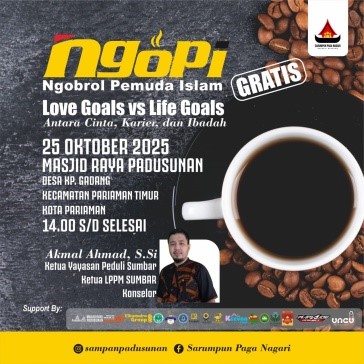
The phenomenon of fragmented life goals among Muslim youth, particularly in understanding the relationship between love, career, and worship, indicates an urgent need to present an educational approach that can link these three dimensions within a single framework of monotheism. From the perspective of Islamic Education, this integration is a prerequisite for the birth of a rabbani generation that has emotional maturity, sharp career vision, and spiritual strength. Based on this need, the community service activity of the Sarumpun Paga Nagar Islamic Youth Chat was held to strengthen the relational awareness of Pariaman City youth regarding love goals and life goals based on Islamic values. The purpose of this community service research is to analyze the process and impact of the educational-participatory program in increasing youth understanding of the connection between love, career, and worship, and to assess the extent to which this activity is able to form a more focused and worship-valuable life orientation. The method used is Participatory Action Research (PAR), which positions youth as active subjects in the process of problem identification, change actions, critical reflection, and follow-up planning. The results of the activity show a significant increase in youth understanding of the organic relationship between love, career, and worship from the perspective of Islamic Education. Participants were able to formulate more realistic, measurable love and life goals, centered on the values of monotheism. Furthermore, they experienced attitudinal changes, including increased spiritual awareness, reflective skills, and a readiness to live a more visionary and worshipful life. In conclusion, this program is effective in strengthening youth relational awareness and serves as a relevant Islamic educational model for developing a rabbani generation. The participatory approach, based on Islamic educational values, has proven to be effective in delivering sustainable transformations in understanding and behavior among Muslim youth
Downloads
References
Asrofi, A., Hamilaturroyya, H., & Purwoko, P. (2025). Asesmen pembelajaran profetik dalam pendidikan Islam: Strategi holistik untuk penguatan nilai spiritual dan karakter peserta didik. STRATEGY: Jurnal Inovasi Strategi Dan Model Pembelajaran, 5(2), 66–78.
Jaya, I. B. (2022). Agama dan politik identitas: Studi persepsi organisasi kepemudaan Islam Kabupaten Bandung tentang pemimpin perempuan. Universitas Islam Negeri Sunan Gunung Djati Bandung.
Maesaroh, M. (2025). Pola komunikasi dakwah interaktif dalam program Belajar Bersama Orangtua (BERSATU): Studi deskriptif model komunikasi di Lembaga Kuttab Cimahi Jawa Barat. UIN Sunan Gunung Djati Bandung.
Masruhim, A., & Sjamsir, H. (2025). Model Manajemen Pembelajaran Rabbani: Integrasi Nilai-Nilai Islam dalam Peningkatan Karakter Mahasiswa. Indonesia Emas Group.
NINDA, K. C. (2023). NILAI-NILAI PENDIDIKAN ISLAM DALAM BUKU KIAI UJANG DI NEGERI KANGURU KARYA NADIRSYAH HOSEN DAN RELEVANSINYA TERHADAP PEMBELAJARAN PENDIDIKAN AGAMA ISLAM DI SMA. UIN PROF. KH SAIFUDDIN ZUHRI PURWOKERTO.
Pratama, A. (2019). Nilai-Nilai Pendidikan Islam Dan Pola Asuh Orang Tua Dalam Falsafah Hidup Adat Minangkabau (Adat Basandi Syara’, Syara’basandi Kitabullah) Untuk Melahirkan Masyarakat Yang Tangguh, Di Kota Payakumbuh, Sumatera Barat. Universitas Islam Indonesia.
Suryadi, A. (2024). Dinamika Pendidikan Islam: Perspektif Historis Dan Tantangan Modern. CV Jejak (Jejak Publisher).
Wijaya, S. (2020). Membangun Relasi Gender Melalui Pendidikan Andragogi Berbasis Al-Qur’an. Institut PTIQ Jakarta.
Downloads
Published
Issue
Section
License
Copyright (c) 2026 Journal of Humanity Dedication

This work is licensed under a Creative Commons Attribution-NonCommercial-ShareAlike 4.0 International License.