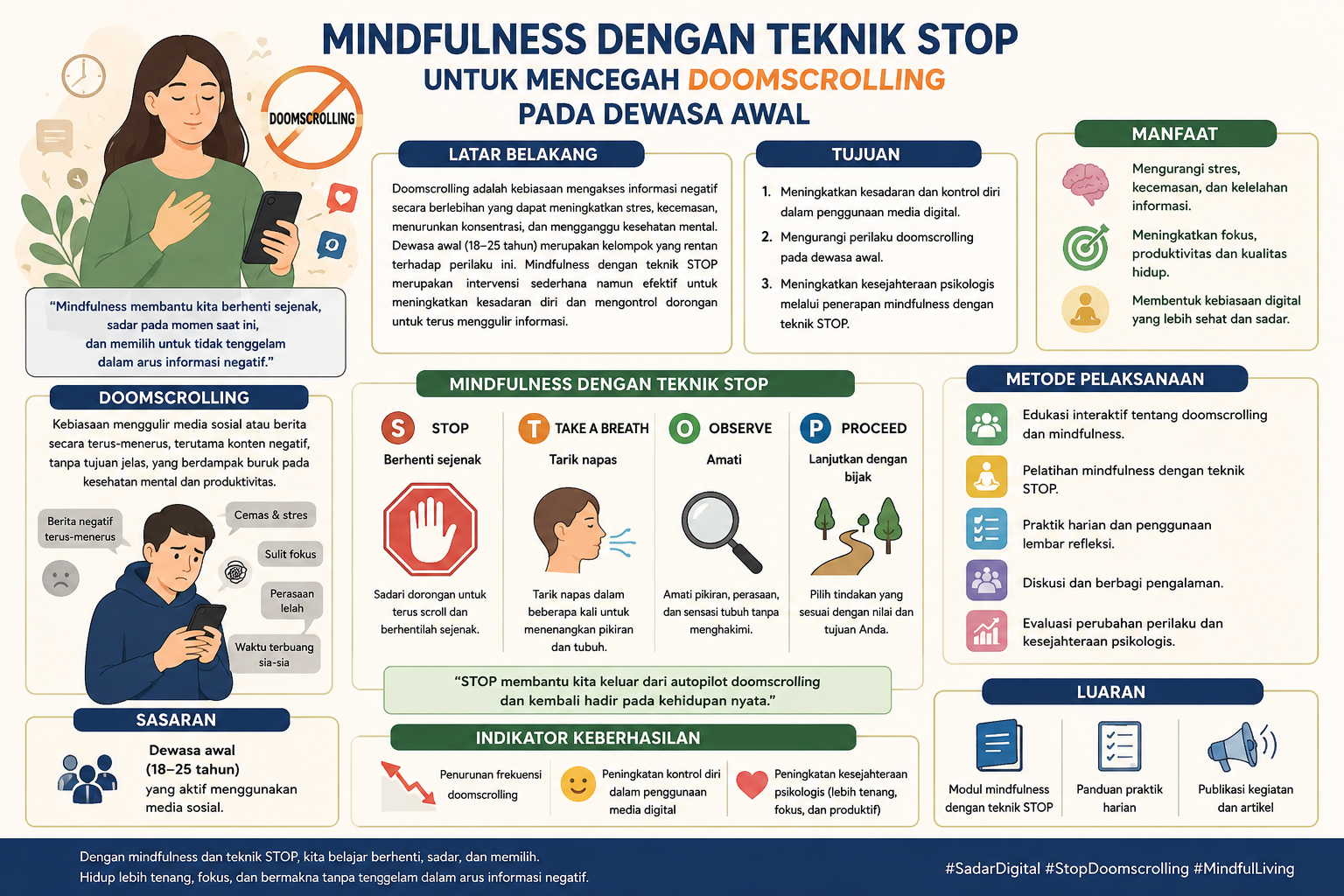
MINDFULNESS DENGAN TEKNIK STOP UNTUK MENCEGAH DOOMSCROLLING PADA DEWASA AWAL
DOI:
https://doi.org/10.55062/1187Keywords:
Doomscrolling, Early Adulthood, Mindfulness, Teknik StopAbstract
The digital era is characterized by unlimited access to information via social media, and now has fundamentally transformed news consumption patterns. While algorithmic curation and the delivery of relevant content can facilitate information retrieval, they may also undermine an individual’s capacity for self-regulated social media usage. An emergent phenomenon known as 'doomscrolling' encompasses compulsive behaviors driven by excessive scrolling and algorithmically generated content. This study investigates cognitive awareness and preventative strategies for doomscrolling through mindfulness-based techniques to mitigate the adverse effects of prolonged exposure to negative media content. The study involved 22 participants within the age range of 19–27 years. The findings indicate a significant increase in participants' cognitive awareness regarding doomscrolling, although challenges in reducing overall social media consumption persist.
Downloads
References
Afandi, A., Laily, N., Wahyudi, N., Umam, M. H., Kambau, R. A., Rahman, S. A., Sudirman, M., Dwi, J., Rika, N. A. K., Junaid, S., Nur, S. W., Jarot, Parmitasari, A., Nurdiyanah, & Wahid, M. (2022). Metodologi Pengabdian Masyarakat (1st ed.).
https://kkn.stainkepri.ac.id/storage/files/downloads/9nUGmKZSYyk40ltORZ5Ld6TekdnbkjwopnpsMheo.pdf
APJII Jumlah Pengguna Internet Indonesia Tembus 221 Juta Orang. (2024). https://apjii.or.id/berita/d/apjii-jumlah-pengguna-internet-indonesia-tembus-221-juta-orang
Bhakti Sharma, Lee, S. S., & Johnson, B. K. (2022). The Dark at the End of the Tunnel: Doomscrolling on Social Media Newsfeeds. Technology, Mind, and Behavior, 3(1), 144–156.
Bintang, J. M. (2023). Pengaruh Sosial Media pada Masa Dewasa Awal. Pensa: Jurnal Pendidikan Dan Ilmu Sosial, 5(3).
Cahyono, A. S. (n.d.). Anang Sugeng Cahyono, Pengaruh Media Sosial Terhadap Perubahan Sosial Masyarakat di Indonesia. 140–157.
Fitriani, L. A., & Wardani, S. Y. (2026). DAMPAK DOOMSCROLLING TERHADAP PROKRASTINASI AKADEMIK MAHASISWA DI ERA DIGITAL. Jurnal Bimbingan Konseling Dan Psikologi (JUBIKOPS), 6(1).
George, A. S., George, A. . H., Baskar, D. T., & Karthikeyan, M. . (2024). Reclaiming Our Minds: Mitigating the Negative Impacts of Excessive Doomscrolling. Partners Universal Multidisciplinary Research Journal (PUMRJ), 1(3). https://doi.org/10.5281/zenodo.13737987
Gordesli, B. K., Mccrae, N., & Grealish, A. (2019). A systematic review: the influence of social media on depression, anxiety and psychological distress in adolescents. International Journal of Adolescence and Youth, 25(1), 1–15. https://doi.org/10.1080/02673843.2019.1590851
Holman, E. A., Garfin, D. R., Lubens, Pauline Silver, & Cohen, R. (2019). Media Exposure to Collective Trauma, Mental Health, and Functioning: Does It Matter What You See? ASSOCIATION FOR PSYCHOLOGICAL SCIENCE, 1–14.
Houston, R., Copper, A., & Ford, T. (2024). Doomscrolling and psychological well-being: A systematic review. Computers in Human Behavior Reports.
Joormann J, Q. M. (2014). Cognitive processes and emotion regulation in depression. Depress Anxiety, 31(4), 308–315.
Junawan, H., & Nurdin Laugu. (2020). Eksistensi Media Sosial,Youtube, Instagram dan Whatsapp Ditengah Pandemi Covid-19 Dikalangan Masyarakat Virtual Indonesia. Baitul Ulum: Jurnal Ilmu Perpustakaan Dan Informasi, 4(1). https://doi.org/https://doi.org/10.30631/baitululum.v4i1.46
Krisnadi, B., & Adhandayani, A. (2022). KECANDUAN MEDIA SOSIAL PADA DEWASA AWAL: APAKAH DAMPAK DARI KESEPIAN? JCA of Psychology, 3(1).
L, E., & J, V. den B. (2016). Bedtime mobile phone use and sleep in adults. Soc Sci Med.
Lee, Y., Jeon, Y. J., Kang, S., Shin, J. Il, Jung, Y.-C., & Jung, S. J. (2022). Social media use and mental health during the COVID-19 pandemic in young adults: a meta-analysis of 14 cross-sectional studies. BMC Public Health, 22(1). https://doi.org/10.1186/s12889-022-13409-0
Lestari, Y. M., Dewi, S. Y., & Chairani, A. (2020). Hubungan Alexithymia dengan Kecanduan Media Sosial pada Remaja di Jakarta Selatan. Scripta Score Scientific Medical Journal, 1(2). https://doi.org/https://doi.org/10.32734/scripta.v1i2.1229.
Montag, C., & Walla, P. (2016). Carpe diem instead of losing your social mind: Beyond digital addiction and why we all suffer from digital overuse. Cogent Psychology, 3(1).
Nolen-Hoeksema, S., Wisco, B. E., & Lyubomirsky, S. (2008). No Title. Perspect Psychol Sci, 3(5).
Phang, C.-K., Keng, L. S., & Chiang, K.-C. (2014). Mindful-S.T.O.P.: Mindfulness Made Easy for Stress Reduction in Medical Students. Education in Medicine Journal, 6(2), 48–56.
Satici, S. A., Tekin, E. G., Deniz, M. E., & Satici, B. (2023). Doomscrolling Scale: its Association with Personality Traits, Psychological Distress, Social Media Use, and Wellbeing. Applied Research in Quality of Life, 18(2), 833–847.
Sharpe, A. T. R., Tyndall, I., Poulus, D. R., & Obine, E. A. C. (n.d.). The Influence of Doomscrolling on Mental Health: A Scoping Review Alexander T. R. Sharpe. Mental Health and Digital Technologies. https://doi.org/10.1108/MHDT-10-2025-0068
Tandon, A., Kaur, P., Dhir, A., & Mäntymäki, M. (2020). Sleepless due to social media? Investigating problematic sleep due to social media and social media sleep hygiene. Computers in Human Behavior.
Usman, S., Huma, T., Akbar, M. R., & Author, C. (2025). Impact of Doomscrolling on Mental Well-being among Media Students in Karachi. Annals of Human and Social Sciences, 6(2).
Winarko, H. B. (2023). Kecemasan Digital: Penggunaan Media Sosial dan Dampaknya terhadap Kesehatan Mental Remaja Indonesia. Soetomo Communication and Humanities, 4, 12–19.
Downloads
Published
Issue
Section
License
Copyright (c) 2026 Journal of Humanity Dedication

This work is licensed under a Creative Commons Attribution-NonCommercial-ShareAlike 4.0 International License.