PEMBERDAYAAN MASYARAKAT DESA LEBAKMUNCANG DALAM MENCEGAH BULLYING MELALUI PEMBELAJARAN HUMANIS BERBASIS TEKNOLOGI
Indonesia
DOI:
https://doi.org/10.55062/1177Keywords:
Bullying, Pembelajaran Humanis, Teknologi Pendidikan, PARAbstract
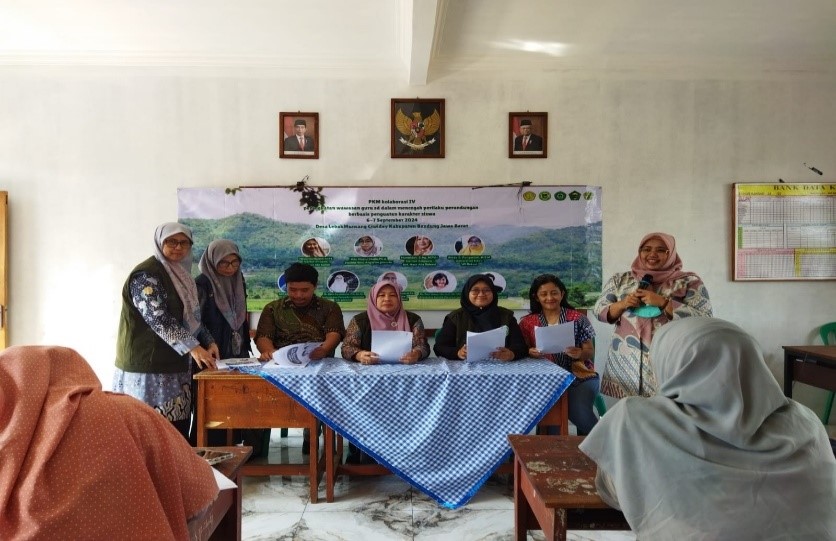
Bagian Perundungan (bullying) masih menjadi persoalan serius di lingkungan pendidikan dasar karena berdampak pada kondisi psikologis siswa, seperti kecemasan, penurunan motivasi belajar, dan terganggunya perkembangan sosial-emosional. Kondisi ini menunjukkan bahwa pendekatan pendidikan konvensional belum sepenuhnya mampu mengintegrasikan nilai-nilai kemanusiaan dan empati dalam proses pembelajaran. Penelitian ini bertujuan untuk mengembangkan dan menerapkan Model Pembelajaran Humanis Berbasis Teknologi sebagai strategi pencegahan bullying pada siswa MI Birrul Walidain, Desa Lebak Muncang, Ciwidey, Bandung. Kegiatan PkM ini memberikan kontribusi nyata kepada masyarakat melalui sosialisasi penguatan kapasitas guru, orang tua, dan komunitas sekolah dalam membangun kesadaran kolektif pencegahan bullying. Luaran strategis pengabdian yaitu pengembangan model H-Tech PAR Anti-Bullying Learning Model, pemanfaatan media edukatif digital, serta penguatan peran komunitas sekolah sebagai agen perubahan anti-bullying. Penelitian ini menggunakan pendekatan Kuantitatif deskriptif-komparatif dalam kerangka Participatory Action Research (PAR) dengan melibatkan guru, kepala sekolah, orang tua, dan masyarakat. Tahapan kegiatan meliputi pre-test, diskusi panel partisipatif berbasis media edukatif, dan post-test untuk mengukur perubahan pemahaman dan sikap peserta. Hasil pre-test menunjukkan rata-rata pemahaman awal peserta sebesar 31%. Setelah penerapan model pembelajaran humanis berbasis teknologi, hasil post-test meningkat secara substansial dengan rata-rata mencapai 99%. Peningkatan paling menonjol terjadi pada pemahaman dampak bullying terhadap korban dan pelaku, serta meningkatnya kesadaran akan pentingnya pencegahan bullying berbasis empati, komunikasi non-kekerasan, dan partisipasi komunitas. Temuan ini menegaskan bahwa penerapan Model Pembelajaran Humanis Berbasis Teknologi selaras dengan tujuan penelitian dan efektif sebagai strategi pencegahan bullying di sekolah dasar. Model ini bersifat aplikatif, partisipatif, dan berpotensi dikembangkan serta direplikasi pada konteks pendidikan yang lebih luas.
Downloads
References
Afnita, N., Kadir, A., Kustati, M., Sepriyanti, N., & Wandi, J. I. (2024). INTEGRASI NILAI-NILAI AL-QUR’AN DALAM PENDEKATAN KONSELING: TINJAUAN KESEHATAN MENTAL REMAJA KORBAN CYBERBULLYING. In Jurnal RAP (Riset Aktual …
Amelia, M., & Ramadan, Z. H. (2021). Implementasi Pendidikan Karakter Melalui Budaya Sekolah di Sekolah Dasar. Jurnal Basicedu, 5(6), 5548–5555. https://doi.org/10.31004/BASICEDU.V5I6.1701
Andriyani, H., Idrus, I. I., & Suhaeb, F. W. (2024). Fenomena Perilaku Bullying di Lingkungan Pendidikan. Jurnal Ilmiah Profesi Pendidikan, 9(2), 1298–1303. https://doi.org/10.29303/JIPP.V9I2.2176
Arango, C., Martín-Babarro, J., Abregú-Crespo, R., Huete-Diego, M., Alvariño-Piqueras, M., Serrano-Marugán, I., & Díaz-Caneja, C. M. (2024). A web-enabled, school-based intervention for bullying prevention (LINKlusive): a cluster randomised trial. EClinicalMedicine, 68, 102427. https://doi.org/10.1016/J.ECLINM.2024.102427
Benítez-Sillero, J. de D., Falla, D., Córdoba-Alcaide, F., & Zych, I. (2024). Bullying, cyberbullying, and empathy as longitudinal predictors of self-esteem. Psychology, Society & Education, 16(3), 63–71. https://doi.org/10.21071/PSE.V16I3.16243
Božić, S., & Marković, M. (2024). Prevention of peer violence by implementing teaching contents: Example of literature instruction in primary school. Inovacije u Nastavi, 37(1), 32–42. https://doi.org/10.5937/INOVACIJE2401032B
Cahyanto, B., Mukhtar, A. S., Iliyyun, Z. B. M., & Faliyandra, F. (2022). Penguatan Pendidikan Karakter di Sekolah Dasar: Studi Implementasi di SD Brawijaya Smart School. Jurnal Pemikiran Dan Pengembangan Sekolah Dasar (JP2SD), 10(2), 202–213. https://doi.org/10.22219/JP2SD.V10I2.22490
Chen, J., Hughes, S., & Ranade, N. (2023). Reimagining student-centered learning: Accessible and inclusive syllabus design during and after the COVID-19 pandemic. Computers and Composition, 67, 102751. https://doi.org/10.1016/J.COMPCOM.2023.102751
Cortes, S. T. (2025). Advancing science education through a participatory action research guide for science teachers. Social Sciences & Humanities Open, 12, 102077. https://doi.org/10.1016/J.SSAHO.2025.102077
De Luca, L., Nocentini, A., & Menesini, E. (2019). The teacher’s role in preventing bullying. Frontiers in Psychology, 10(AUG). https://doi.org/10.3389/FPSYG.2019.01830/PDF
Diac, G., & Grădinariu, T. (2023). Successful Bullying Prevention: a Curriculum Based on Cooperative Learning – Theoretical Analysis. Revista Romaneasca Pentru Educatie Multidimensionala, 15(1), 657–670. https://doi.org/10.18662/RREM/15.1/716
Dietrich, L., Jurkowski, S., Schwarzer, N. H., & Zimmermann, D. (2023). The role of teachers in the bullying involvement of students with emotional and behavioral difficulties. Teaching and Teacher Education, 135, 104311. https://doi.org/10.1016/J.TATE.2023.104311
Fatmasari, Apriani, A.-N., Sudaryanti, A. A., Sofian, M., Rahayu, D. P., Fetinarumi, Azman, M., Putri, N., Akbar, M., Lestari, S. B., & Haabiburochman, Y. K. (2024). Edukasi Anti Bullying bagi Siswa di Sekolah Dasar. Jurnal Indonesia Mengabdi, 6(2), 145–154. https://doi.org/10.30599/0CRPMD20
Gabrhelová, G., Pasternáková, L., & Barnová, S. (2024). Reducing the Incidence of Bullying in Secondary Schools. Emerging Science Journal, 8(Special issue), 444–460. https://doi.org/10.28991/ESJ-2024-SIED1-026
Kasanah, S., Rosyadi, Z., Pd, M., Punggeti, R., & Arifin, F. (2024). Pendidikan Anti Bullying. https://books.google.com/books?hl=id&lr=&id=lQDwEAAAQBAJ&oi=fnd&pg=PR5&dq=Abdurrohim+2024+pendidikan+anti+bullying+nilai+humanistik&ots=j6eFfu7lBM&sig=EEQ3EYT91OftiH_VxQsapXOeENg
Malorni, A., Lea, C. H., Richards-Schuster, K., & Spencer, M. S. (2022). Facilitating youth participatory action research (YPAR): A scoping review of relational practice in U.S. Youth development & out-of-school time projects. Children and Youth Services Review, 136, 106399. https://doi.org/10.1016/j.childyouth.2022.106399
Aminah, Hairida, & Hartoyo, A. (2022). Penguatan Pendidikan Karakter Peserta Didik melalui Pendekatan Pembelajaran Kontekstual di Sekolah Dasar. Jurnal Basicedu, 6(5), 8349–8358. https://doi.org/10.31004/BASICEDU.V6I5.3791
Qiu, T., Wang, S., Hu, D., Feng, N., & Cui, L. (2024). Predicting Risk of Bullying Victimization among Primary and Secondary School Students: Based on a Machine Learning Model. Behavioral Sciences, 14(1). https://doi.org/10.3390/BS14010073
Saleh, M. N. I., Hanum, F., & Rukiyati. (2025). Stakeholders’ perspectives on whole-school approaches to prevent and address bullying and cyberbullying in Indonesian high schools. Social Sciences & Humanities Open, 12, 102336. https://doi.org/10.1016/J.SSAHO.2025.102336
Serritella, E., Guazzini, A., & Menesini, E. (2025). Countering bullying and cyberbullying using technology-based solutions: a systematic review. Aggression and Violent Behavior, 85, 102102. https://doi.org/10.1016/J.AVB.2025.102102
Suratno, S., Wantini, W., Suyatno, S., Perawironegoro, D., & Arqam, M. L. (2022). Bullying Prevention Method in High School with Humanistic-Religious Approach. Journal of Social Science, 3(6), 1255–1265. https://doi.org/10.46799/JSS.V3I6.475
Tokunaga, R. S. (2010). Following you home from school: A critical review and synthesis of research on cyberbullying victimization. Computers in Human Behavior, 26(3), 277–287. https://doi.org/10.1016/J.CHB.2009.11.014
Tremblay-Wragg, É., Mathieu-Chartier, S., Déri, C. E., Beaupré-Boivin, K., & Lafrance St-Martin, L. I. (2025). Participatory Action Research: A Gateway to the Professionalization of Emerging Scholars. Trends in Higher Education 2025, Vol. 4, 4(3). https://doi.org/10.3390/higheredu4030029
Werthner, H., Prem, E., Lee, E. A., & Ghezzi, C. (2022). Perspectives on Digital Humanism (H. Werthner, E. Prem, E. A. Lee, & C. Ghezzi, Eds.). Springer International Publishing. https://doi.org/10.1007/978-3-030-86144-5
Wibowo, A., William, R. F., & Kacimaiwai, P. (2022). The Implementation of Jigsaw Learning Model in Prevention of Bullying in Fourth Grade Students. Elementary Education Journal, 1(2), 94–103. https://doi.org/10.53088/EEJ.V1I2.294
Yosep, I., Iskandar, S., Mardhiyah, A., Ramdhani, M. R., & Hikmat, R. (2026). The effect of the ROOTS Program on empathy and bullying behavior in high school students in Bandung. International Journal of Africa Nursing Sciences, 24(1), 100995. https://doi.org/10.1016/j.ijans.2026.100995
Zuber-Skerritt, O. (2015). Participatory Action Learning and Action Research (PALAR) for Community Engagement: A Theoretical Framework. Educational Research for Social Change. https://research-repository.griffith.edu.au/bitstreams/17b1692d-0133-58d3-86d3-dc1f89b5433a/download
Downloads
Published
Issue
Section
License
Copyright (c) 2026 Journal of Humanity Dedication

This work is licensed under a Creative Commons Attribution-NonCommercial-ShareAlike 4.0 International License.